Understanding Peptide Pureness: What 99%+ Actually Indicates
The gold criterion for determining peptide pureness is high-performance liquid chromatography, generally abbreviated as HPLC. If you see a purity percent on a peptide item, it likely originated from an HPLC analysis. This issues since peptides are built one amino acid at a time via solid-phase peptide synthesis (SPPS). At each action, there's a small opportunity that something fails-- an Click here for more info amino acid does not connect, the wrong alteration takes place, or a side response produces an unintended byproduct. Over a chain of 10, 20, or 40 amino acids, those tiny per-step error rates substance.If you have actually ever browsed a peptide brochure, you have actually seen purity numbers all over. These numbers obtain thrown around so typically that it's easy to play down them-- just one more spec on a product web page. Chameleon Peptides sells research substances specifically for laboratory and logical purposes. All PRG products are intended solely for artificial insemination research study or additional manufacturing usage. Using an extremely detoxified peptide minimizes these threats and boosts the reliability of your data.
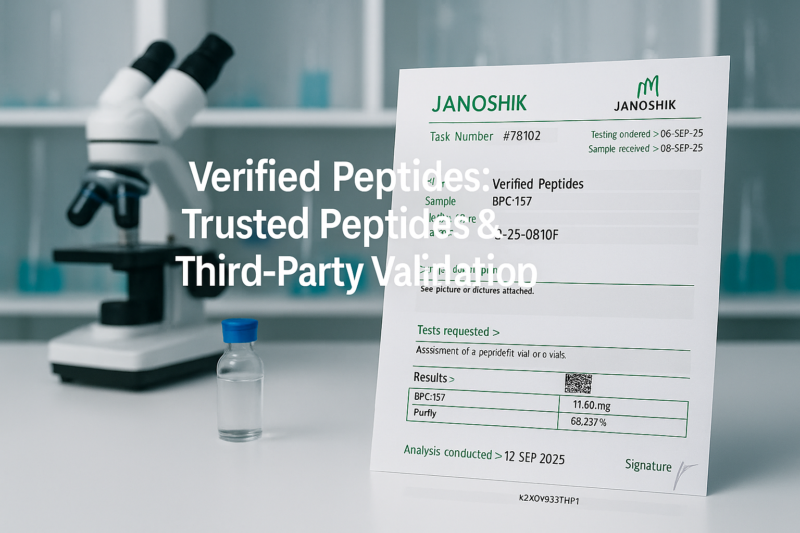
Why Select Our Peptide Chemical & Physical Evaluation System
At Maxed Out Compounds, every product we supply comes with a clear testing document and clear paperwork. Our mission is to support scientists with high-purity, verified substances that satisfy the demands of modern-day scientific research study-- nothing more, nothing much less. Independent, third-party screening plays an essential role in making sure neutrality and accuracy. By using exterior labs for confirmation, providers eliminate prejudice and maintain clinical reputation. It's an extra step that gives scientists confidence that each peptide meets regular, verifiable requirements. This quality matches the majority of in vitro research study applications-- receptor binding assays, enzyme task research studies, and cell society experiments.Kinds Of Pollutants Hplc Identifies
Straight from the synthesizer with minimal processing-- normally simply cleavage Article source from the resin and precipitation. Pureness varies commonly, from 40% to 80%+ depending upon series size and trouble. Crude peptides appropriate for applications where purity isn't vital, such as antibody manufacturing or first testing assays where the target peptide just needs to be existing, not dominant. Closely related to truncations, deletion peptides are unabridged chains that are missing out on one amino acid somewhere between. If capping isn't completely reliable, an uncoupled chain can remain to lengthen in succeeding steps, producing a peptide that's only one residue except the target.A single generic chromatographic approach is commonly not enough for peptides that are hydrophobic, extremely fundamental, very closely relevant in turn, or partly purified. We provide HPLC and UPLC pureness analysis process that concentrate on useful separation instead of only producing a portion. We develop analytical process around the example type, sequence functions, adjustment profile, and decision context. Tasks may entail crude intermediates, purified peptides, kept great deals, client-supplied materials, or products produced with our custom-made peptide synthesis system.
These can be particularly bothersome due to the fact that their chromatographic habits is very similar to the target peptide, making them tougher to separate during filtration. When a peptide is 98% pure, that remaining 2% isn't random sound-- it specifies, recognizable sorts of by-products. Mass spectrometry measures the molecular weight of a compound with extreme accuracy. For peptides, one of the most typical strategies are electrospray ionization (ESI-MS) and matrix-assisted laser desorption/ionization time-of-flight (MALDI-TOF). HPLC separates a combination into its private elements based upon exactly how each particle communicates with a particularly created column.
- In addition, mass spectrometry (MS) can be used to verify the peptide's molecular weight and series, supplying further confirmation of purity by finding contaminants and degradation products.Knowledge of pureness degrees will certainly likewise direct you if you ever before require a higher pureness peptide for a specifically sensitive assay.The bottom line is not to confuse purity (HPLC portion of the main peptide vs pollutants) with total web content.It helps prevent compliance problems such as fallen short audits or product remembers because of quality flaws.